Growing up as the child of immigrant parents — and with my dad being Egyptian — I was surrounded by traces of Egypt at home: the food, the music, the celebrated old films that drifted through our living room. But I didn’t really know Egypt. I’d only been twice as a child, and by the time I became an adult, those memories had faded.
So I made myself a quiet promise: one day, I would return — not just to visit, but to feel the half-Egyptian part of me I never truly got to know.
On my recent trip to Cairo, the thing that caught my attention most wasn’t the pyramids or museums, but something far more ordinary — and far more profound: Aish Baladi, the local Egyptian bread.


In Egyptian Arabic, “aish” means life. Unlike most Arabic-speaking countries, where bread is called khobz, Egyptians use the word “aish” — a subtle but powerful reminder of how essential bread is to their survival and national identity. “Baladi” means traditional or of the country — a word often used to describe something local, homemade, and rooted in heritage.
The sight of this round, rustic flatbread fascinated me.
My parents left their countries and moved to Europe — first to Greece, then Switzerland, and finally to France, which has been their home for over 30 years. And yet, one thing always followed us: the food of their homes.
Whenever my dad traveled back to Egypt for work, he returned with suitcases full of Aish Baladi. He’d freeze the loaves, warm them up slowly in the oven, and savor them — rationing each piece until the next trip.
So this bread became a familiar sight in our kitchen, even though I had never seen what it meant in its homeland.
In Cairo, that changed. I saw what I had always imagined: Aish Baladi isn’t just bread — it’s the soul of the country.
From bakeries, it’s delivered to every corner of Cairo and beyond — supermarkets, restaurants, hotels, street vendors and street food carts. What surprised me most was how it travels: young boys and teenagers weave through chaotic traffic on bicycles, balancing massive wooden trays stacked with fresh bread on their heads.
They ride with unbelievable grace — a kind of dance through Cairo’s storm of cars, motorcycles, tuk-tuks, and pedestrians. These bread boys aren’t just delivery workers; they’re guardians of the country’s lifeline. Even in the madness of Cairo traffic, no one messes with the bread boy. In my mind, I felt like there was an unspoken reverence to the bread boy on the bicycle because of the importance of what he is carrying on his head. In a way, he rules the road.
As someone who’s always believed that food is larger than life — that food is life itself — this struck me deeply.
So I started asking more questions about this bread I’d known all my life, but never fully understood.
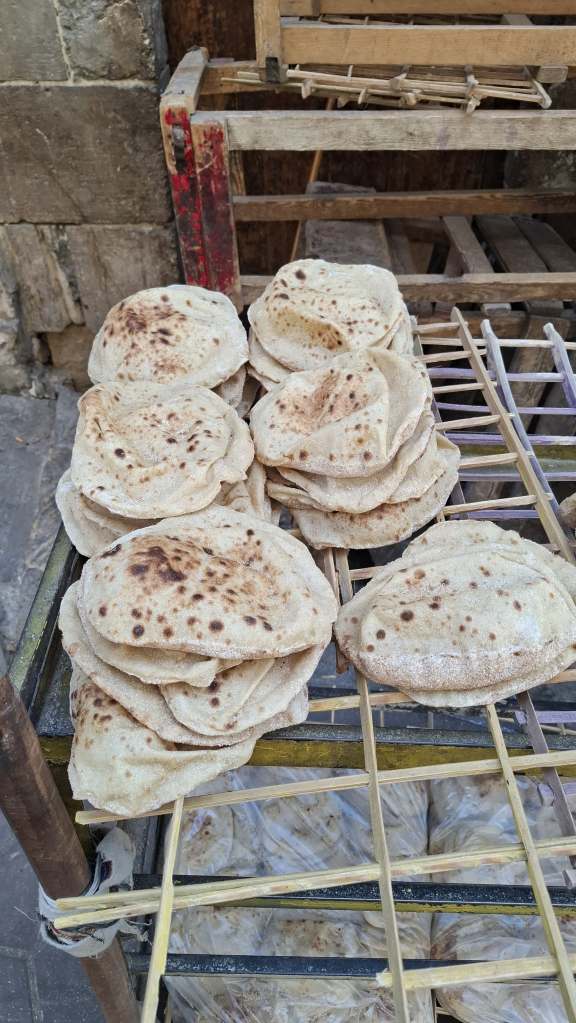
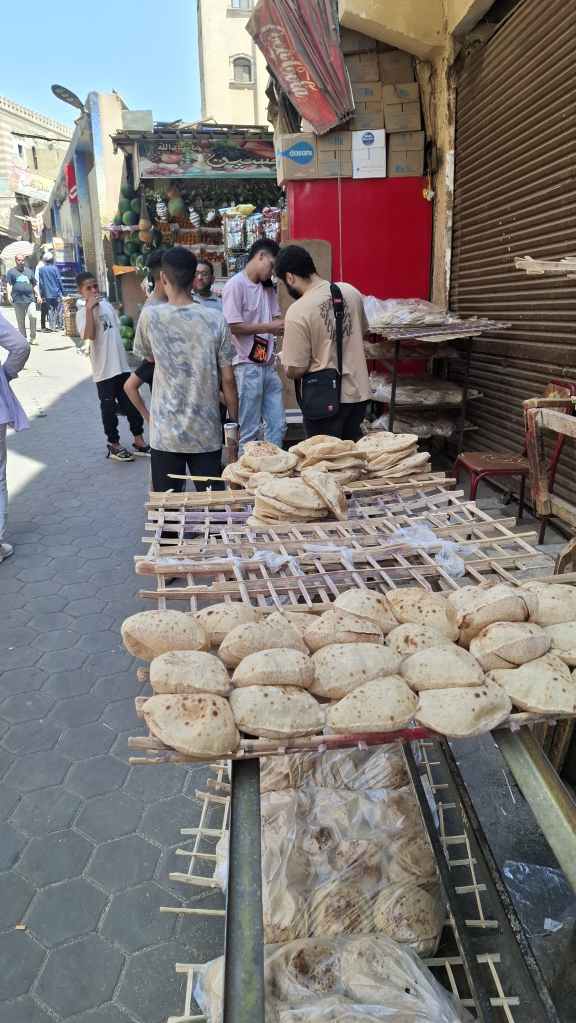
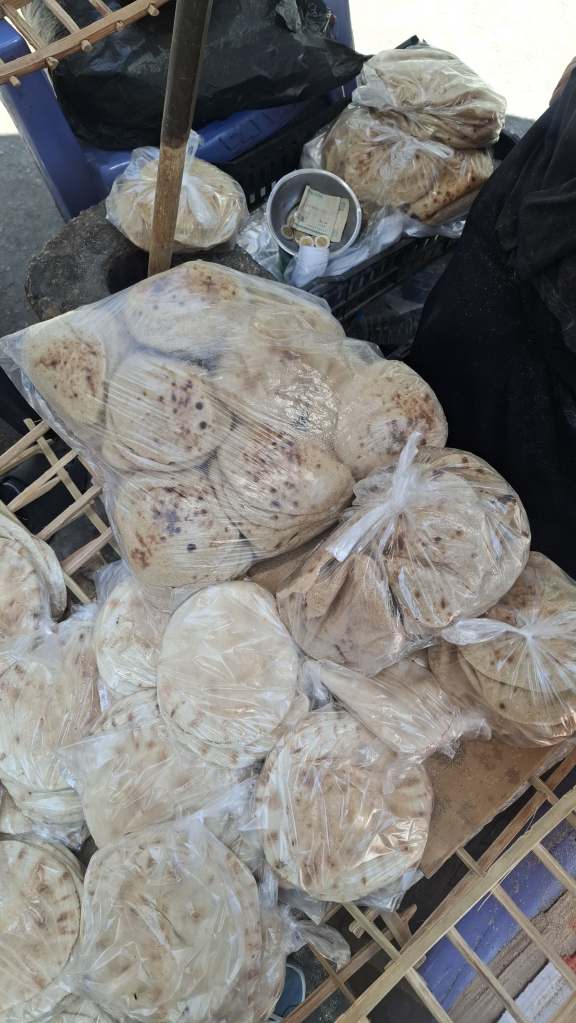
So What Is Aish Baladi, Really?
Many people are familiar with “pita” bread — the soft, round flatbread that puffs up into a pocket, often called “Shami” bread in Arabic. Shami means Levantine (from Bilad al-Sham, the region that includes Syria, Lebanon, Jordan, and Palestine).
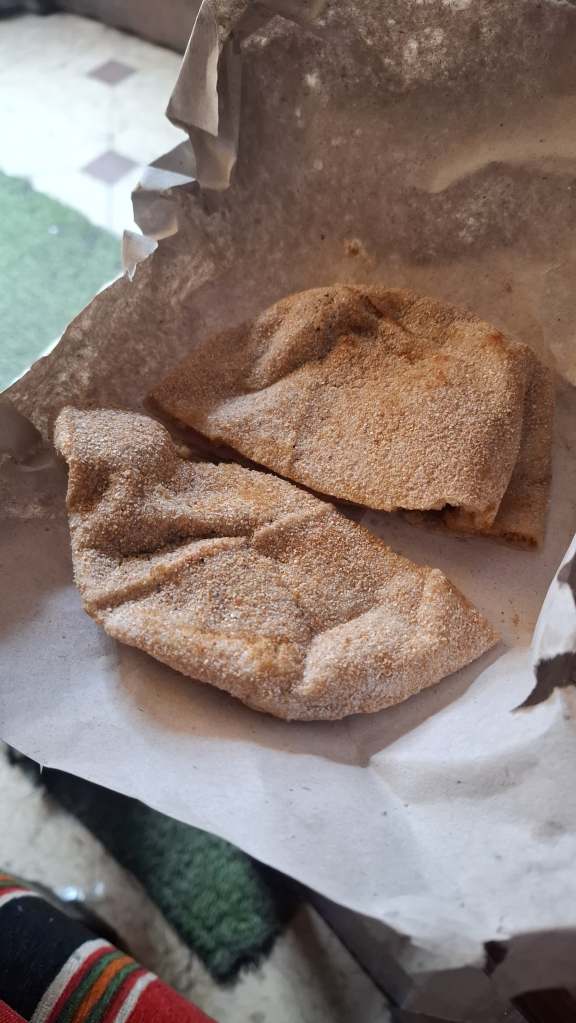
But Aish Baladi is not pita. It’s thicker, earthier, and made from whole wheat flour, often using heirloom or ancient Egyptian grains like emmer wheat (farro) — the same type cultivated along the Nile over 5,000 years ago.
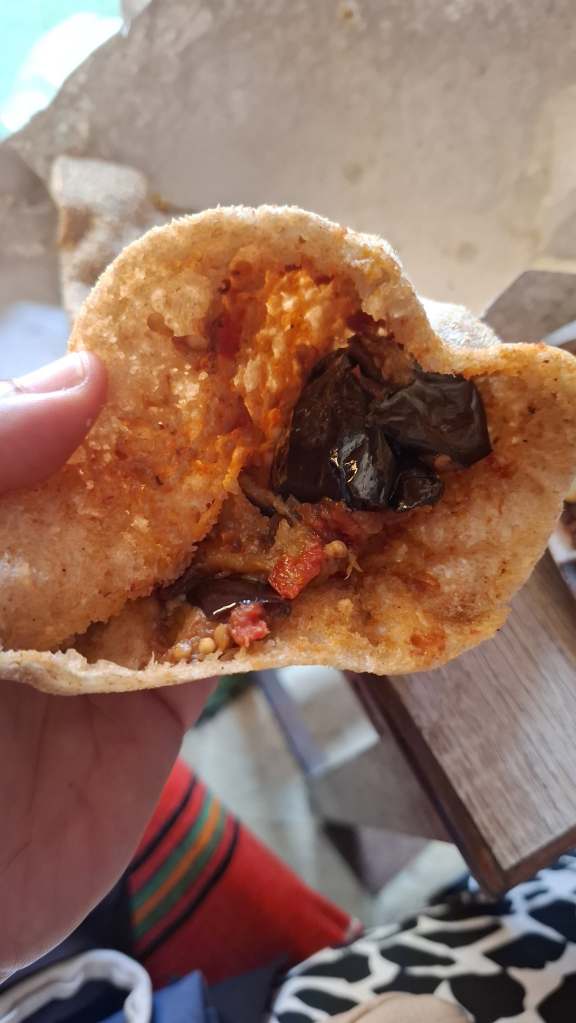
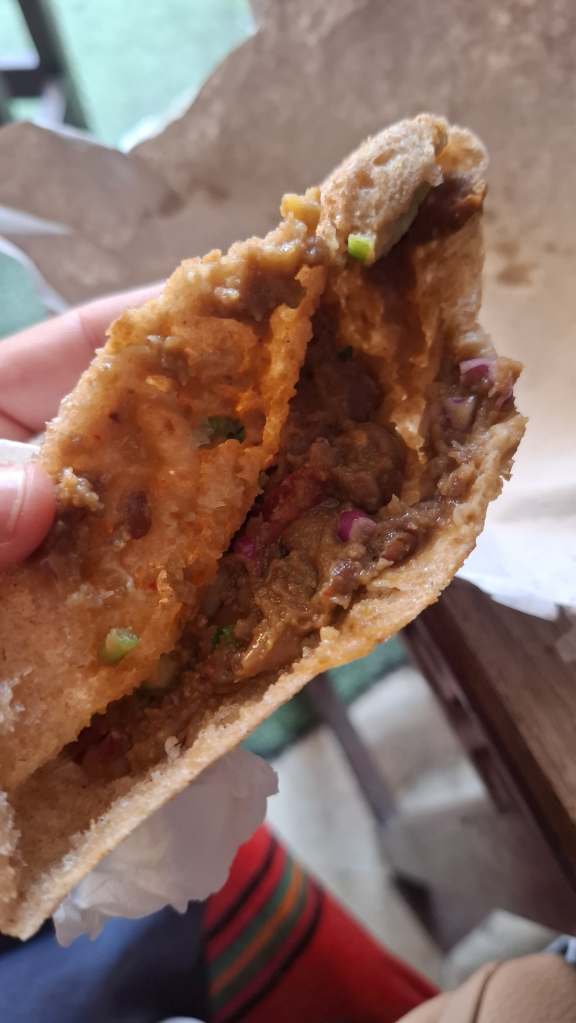
Traditionally, it’s baked in super-hot clay or wood-fired ovens, which causes the dough to puff and create a pocket — perfect for stuffing with falafel, ful medames, or slices of fried eggplant (a must-try sandwich in Egypt, by the way).
But it’s not just about sandwiches. Aish Baladi often replaces cutlery — used to scoop, fold, dip, or wrap food. It’s eaten at almost every meal.
And this isn’t a modern phenomenon. Tomb paintings from Pharaonic times show Egyptians grinding grain, shaping loaves, and baking bread. Bread was placed in tombs, offered in rituals, and seen as sacred.
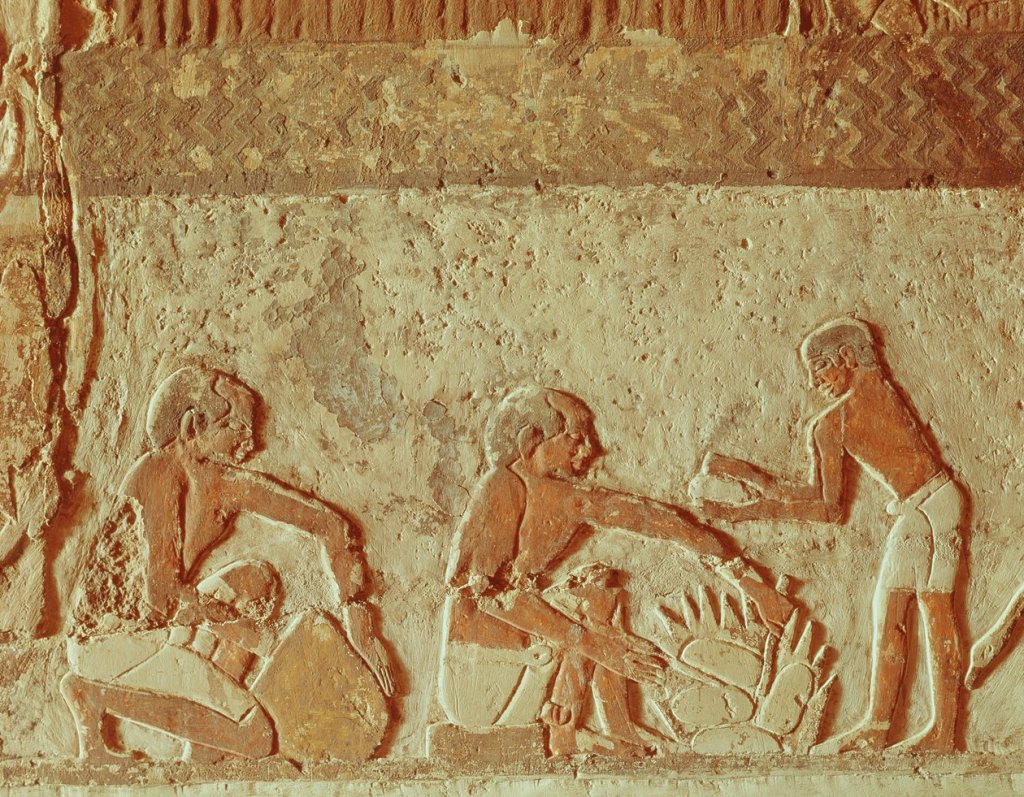
Relief depicting the making and baking of bread, Old Kingdom. Egyptian 5th Dynasty
Bread as a Right, Not a Luxury
Egypt has over 120 million people, and bread is still a lifeline. It’s hard to say exactly how many loaves are made each day — but here’s what we know:
-Over 90 million people receive subsidized Aish Baladi through Egypt’s national bread program.
-Each person is entitled to five loaves per day using a government-issued smart card.
-That adds up to nearly 100 billion loaves per year — or about 274 million loaves every single day. (Yes, you read that right. Every. Single. Day.)
-But here’s the thing: each subsidized loaf costs only 5 piastres — around $0.001 USD. The government pays the rest.
In May 2024, the government announced that the price would rise to 20 piastres — the first increase in 36 years. That may seem small, but in Egypt, raising the price of bread is playing with fire.
Why?
Because bread is not just food. It is the people’s right to live.
Over 70 million Egyptians rely on subsidized bread to survive. In 1977, when President Sadat tried to cut subsidies, riots broke out across the country. Many were killed, and the government was forced to reverse course. During the 2011 revolution, soaring food prices — including bread — were among the sparks that lit the fire.
In Egypt, if you touch the price of bread, you touch the soul of the people.
This is what I came to understand in Cairo — not just intellectually, but emotionally.
I finally saw why my dad packed bread in his suitcase every time he’d go back to Egypt abd why he’d ask me to bring some back this time.
Because Aish Baladi isn’t just bread. It’s a taste of home, a piece of heritage, and a lifeline all at once.
It’s the smell of the past, the warmth of memory, and the proof that Egypt — even thousands of miles away — always found its way back to our kitchen in France.
And now, it has found its way into my heart, too.
If you have any questions, leave a comment below or email me at thefoodcuriouslife (at) gmail (dot) com.
 FOOD CURIOUS
Leave a comment