It’s been less than a week since I decided to take a break from Instagram—the only social media platform I was consistently active on. But something shifted, and I found myself repelled by it.
Increasingly, I hear people around me saying they’re stepping away from social media, whether for a break or permanently. We’ve all heard about the effects of social media on mental health. I can’t even fathom how people juggle three or more platforms when I could barely handle one.
But my reasons for stepping back were a little different—not entirely mental health-related. Instagram never robbed me of sleep or led to mindless scrolling. Instead, it was tied to the particular season of life I’m in: closing a successful restaurant, moving back home, and starting from scratch. The return on investment—emotionally, creatively, and professionally—just wasn’t adding up anymore.
I actually have many reasons as to why I decided to go on an Instagram sabbatical – for as long as I want and need to- and I will tell you all the reasons on here.
The reasons became very evident to me as I took a long walk this morning. Winter gifted us with a glorious sunny day, and I made the most of it. My 8 kilometer walk wove through green spaces and gardens, and I indulged in the crisp pine-scented air invigorating me with every breath.
I observed life as it unfolded around me: dog owners walking their pets, smokers lighting cigarettes at street corners, people quietly reading on park benches. I saw locals heading to work, tourists marveling at monuments, and restaurants meticulously preparing for the sacred weekday, workday, French ritual of lunch—a stark contrast to the “eat at your desk” culture elsewhere.
These simple, mundane yet beautiful moments felt grounding, so unlike the hyper-curated, high-octane world of Instagram, where life seems reduced to highlights on steroids.
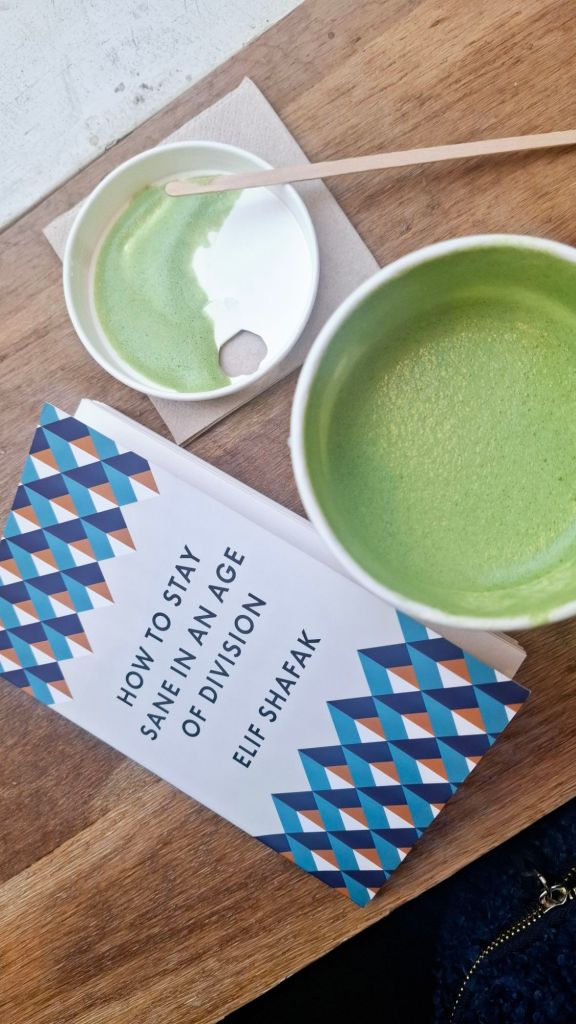
My walk led me to Little Tokyo, a small triangle of Paris dotted with Japanese and also Korean eateries, cafés, and shops. On a friend’s recommendation, I visited Dear Jane, a quaint Korean-owned coffee shop known for its excellent matcha lattes. I ordered mine with oat milk and savored its perfect balance of grassy, umami matcha with just the right creaminess. Non-Asian cafés in Paris often drown the matcha in milk, but this one celebrated the complex vegetal flavor profile of a good quality matcha.
I sat with my latte and finished reading How to Stay Sane in an Age of Division by Elif Shafak. The book urges us to listen to others’ stories- especially those different from ours- and as I turned the pages, I felt relieved to see my concerns reflected. Polarization, division, and distrust are pervasive today—values that run counter to the ethos of Food Curious and my own beliefs about life, in general.
And Instagram was only fueling more polarization, distrust and division.
When I had my own restaurant, Marianna’s Kitchen, Instagram was useful for sharing daily menus and introducing guests to obscure ingredients and forgotten heirloom vegetables. Unintentionally, it became part of my marketing, connecting me to my customers. And before that, in a pre-pandemic, less polarized world, I used Instagram simply to share my love of cooking.
But the world has changed since 2020, and so has the platform. Over the past nine months, since returning to France, I’ve found Instagram uninspiring and exhausting. I convinced myself it was a necessary tool to rebuild my career as a self-taught chef, but the creativity felt stifled by its infamous algorithm.
For starters, the sense of repetitiveness, thanks to this terrible almighty “algorithm” creates a lack of creativity in food, but also a tremendous pressure to follow a certain formula made of close-ups of stretchy cheese, gooey pasta and juicy burgers. An algorithm that asked you to post on certain days and certain time frames to get any sort of decent visibility for the time and money you spend, creating and sharing a recipe.
Most importantly, there was a false sense that authenticity and storytelling could be reduced to 90-second clips, when in fact, real connection (and by extension, authenticity and vulnerability) requires more than a screen.
This pseudo “story telling” and algorithm dictated food world also seemed to spill over into real life. Many restaurants now play it safe, prioritizing Instagram-worthy presentations over bold, authentic flavors. It’s disheartening to see creativity, once a hallmark of good food, become a luxury, while watered-down flavors dominate the mainstream. The same way we want to please an audience online, is the same way I’m seeing restaurants pleasing audiences in real life. I’m not tasting the spice or the story of a recipe passed down from generation to generation.
Social media also fosters echo chambers, where edited, out-of-context content triggers emotions rather than offering complexity or truth. No matter how carefully you curate your feed, polarization and division seep in, creating a universe I no longer want to belong to.
Then there’s the unrealistic expectation of being everything for everyone. As a creative, I was tired of being asked not just about food, but about unrelated topics—like travel advice, Airbnb recommendations and the most random of questions. It felt like people weren’t willing to put in the effort to find answers themselves. On top of all that, Instagram has added unnecessary layers for creatives- where they needed to not only become masters of their craft but also videographers, photographers, experts at understanding good lighting and sound, etc. And let’s be real: being attractive, charismatic and photogenic would also play in your favor. Content creation means you have to become so many things, and often, it feels unsustainable and takes away from the one thing you really love and want to focus on.
As a third-culture kid and child of immigrant parents, I was also frustrated by the narrow lens through which food is presented. Where were the desserts inspired by sweet corn, red beans, or cumin? Why wasn’t there more acknowledgment of how cultures have used ingredients like chickpea flour or dates in desserts for centuries? Why did we have to stick to vanilla or chocolate?
I was tired of seeing “superfoods” like dates and chickpea flour in modern day health conscious recipes, with no mention of cultures that had used both ingredients for centuries in desserts. The lack of interest in tracing down any cultural context represented a trend-driven barbaric consumption of these ingredients. Why was no one (or very few at least) talking about how chickpea flour has been a staple in desserts of Central Asia and the South Asian subcontinent for years now? Why was no one mentioning that dates are not just a trending superfood, but part of the cultural heritage and religious landscape of the Arab world?
I was tired of seeing a lack of tolerance in the comment section on many Instagram posts. It made me think twice about how I talk about veganism, a diet I’ve chosen to adopt, but for reasons that are so different from the generic narrative we hear. I wanted to talk about things like being open to the idea of no longer being a vegan if, in my fifties and menopausal era (which I’m still far away from), I were to find myself in a situation where my body would ask me for more. I’m a firm believer that our bodies know best- and we should never betray our bodies cries. But with the polarized, black and white thinking and culture of social media, I’d probably be criticized by the collective narcissism of what is usually a small, but loud minority online- of those who just want to shout to get attention, rather than engage in an actual respectful conversation.
And lastly, as a woman, I was tired of seeing other women having to post their bodies half naked and use a filter, just to get more attention and boost their online presence.
In a nutshell, Instagram was starting to represent a lot of things that go against my personal values, but also how I see food and how I want people to experience food. The key word here being experience: because when I cook, there’s a story, there are fresh flowers near your plate, there is music I’ve carefully curated, there is conversation, there is warmth and connection.
Social media just doesn’t do that for me.
And so, I’ve decided to go on a sabbatical for as long I want to.
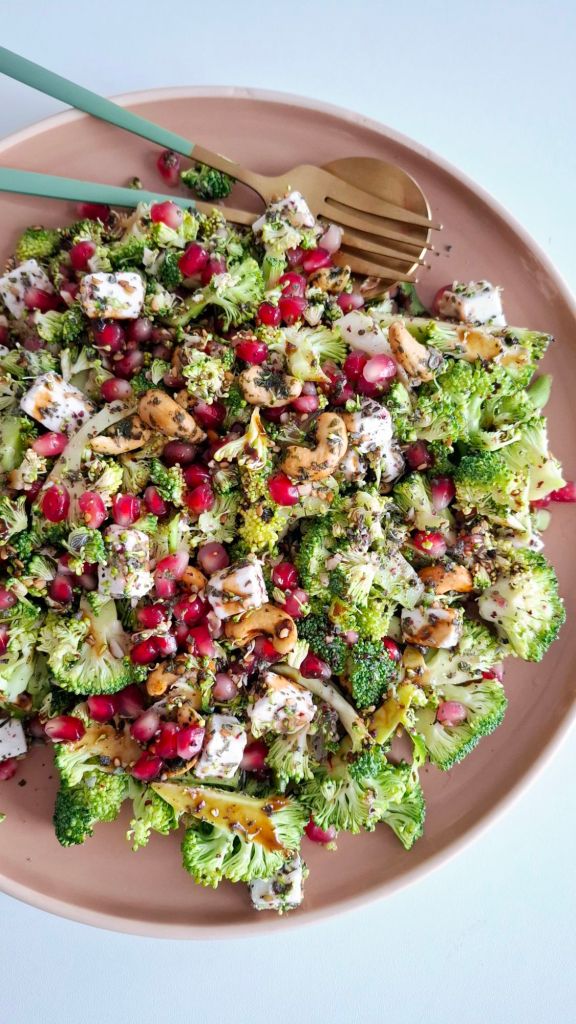
After what turned out to be a 10 km walk, I came back home famished, remembering I had a broccoli and pomegranate in my kitchen. Pomegranates are really in full swing, the ruby red juicy ones are at their lowest price these days. So I’m buying them as often as I can. As a vegetable lover, one recipe I haven’t gotten bored of making lately is a delicious broccoli-pomegranate zaatar salad with vegan feta and cashews. I’ve shared the recipe below, I hope you give it a try.
Lots of love. Feel free to leave a comment or send me an email with your thoughts at thefoodcuriouslife@gmail.com
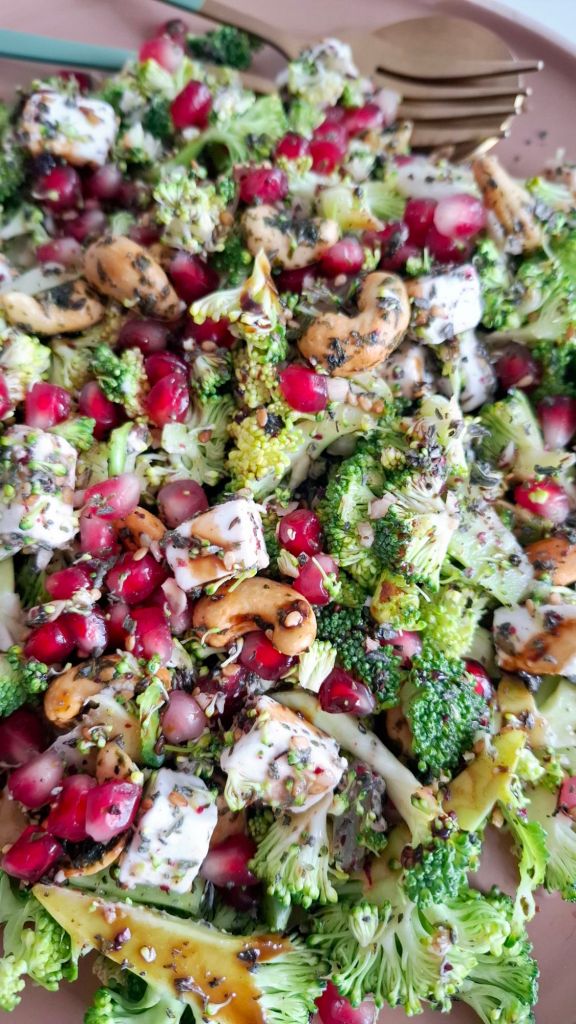
Crunchy Broccoli-Pomegranate Za’atar Salad
Makes 3 servings
Ingredients:
1 head of broccoli, chopped into bite-sized pieces
1/2 pomegranate, seeds only
2 garlic cloves, finely minced
Juice of 1 lemon
1 tsp pomegranate molasses
1 tsp maple syrup
2 tbsp extra virgin olive oil
1 heaping tbsp high-quality za’atar
Vegan feta, diced (adjust to your preference)
Roasted cashews (adjust to your preference)
Salt, to taste
Directions:
In a large mixing bowl, combine the chopped broccoli, pomegranate seeds, and minced garlic.
In a small bowl, whisk together the lemon juice, pomegranate molasses, maple syrup, olive oil, and za’atar.
Pour the dressing over the broccoli mixture and toss until evenly coated. Add salt to taste.
Gently fold in the vegan feta and roasted cashews and give everything one more gentle toss.
Let the salad rest for 15 minutes to allow the flavors to meld.
Serve immediately or store in the fridge overnight or a couple of hours—it tastes even better as the flavors develop!
 FOOD CURIOUS
Leave a comment